Marcelo Was Right (Again) — Square Ball 27/4/26
You Know What You Are
Written by: Dan Moylan
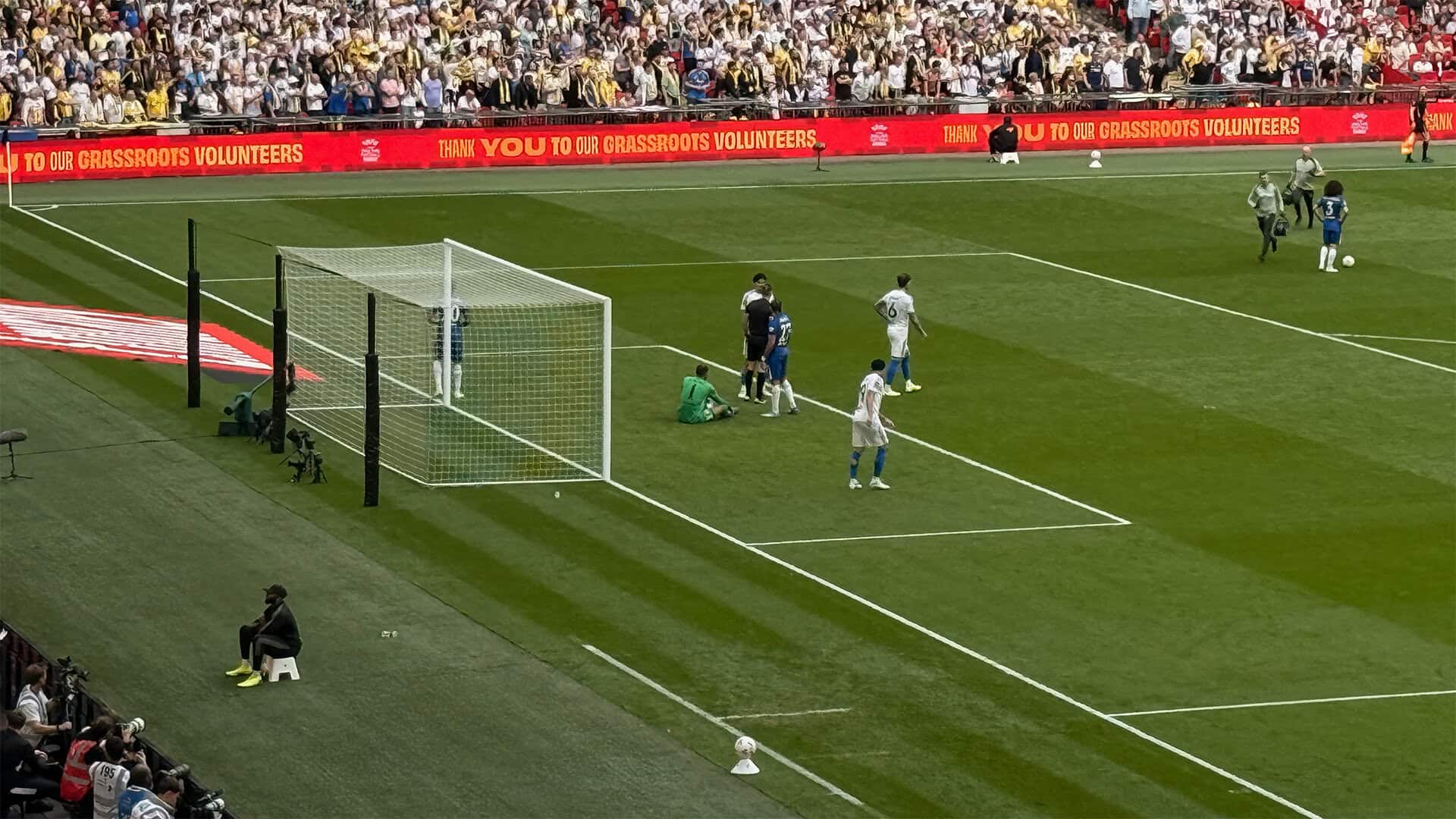
At Wembley on Sunday, with Leeds building pressure in the
second half of the FA Cup semi-final, Robert Sánchez went down. Nothing had
happened. He went down because Chelsea’s interim head coach Calum McFarlane
wanted a moment to deliver tactical instructions. A goalkeeper lying on the
turf is, for now, the most convenient way to get one.
Over eighty-two thousand people inside Wembley knew it.
Millions watching at home knew it. Even Jarred Gillett, the dickhead referee
who continually pandered to Chelsea’s theatrics throughout the game, probably
knew it.
Nobody was pretending otherwise.
Some hours later we were sat silently in a traffic jam on
the M1 northbound, somewhere near Luton or Milton Keynes or Northampton or
wherever. I returned to the question that often takes root in my brain: what
would Marcelo think?
Calum McFarlane, speaking after the game, brushed off the
criticism, saying matter-of-factly, “I used it as an opportunity to talk to the
players and get the information out there that we needed.” It’s not just the
act itself, but the naked indifference to doing it. The win-at-all-costs
mentality is not new – football has always had a dark arts tradition – but
there used to be some residual shame attached. At the Etihad earlier this
season, against Brentford at Elland Road, and now at Wembley Stadium, the script
stays the same: a goalkeeper goes down holding his thigh in a gloved hand, his
teammates gather for instructions, and everyone agrees to carry on as if
nothing extraordinary is happening. Except Ethan Ampadu. Bravo to the skipper
for placing himself in the Chelsea huddle to shine a light on this cynical
farce.
The rules, as they are currently applied, give match
officials no meaningful power to intervene. It’s the same with players who go
down clutching their heads. A University of Glasgow study has established clear
links between head impacts in football and neurodegenerative diseases.
Concussion protocols have been tightened up. The football authorities are
staring cautiously at the thin end of a thick, problematic wedge. Referees are
now programmed to put player welfare first, while players simply treat this caution
as a new loophole to exploit. Ampadu, composed as ever despite the
disappointment of the day, offered the obvious: “Everyone knows the referee
can’t do anything.”
This isn’t a moral panic, to be clear. Moral panics are
nothing new in football. Dribbling was going to destroy football. Diving was
going to destroy football. The backpass rule, VAR, Premier League money,
agents, the Bosman ruling, international breaks. They may have all contributed
to a changing direction of travel, but football continues to be watched by more
people than almost anything else on earth.
Marcelo Bielsa is not prone to moral panics. He is, by
temperament, a man who thinks in systems. But his systems are overlaid on an
art form. Art is about provoking a response in its viewer. Bielsa pursues
beautiful football in order to please the crowd. This underpins what he says –
what he has always said.
“I am certain that football is in a process of decline,” he
said at a Copa America press conference in July 2024. “More and more people are
watching this sport, but it is becoming less and less attractive.” Bielsa’s
diagnosis points to a truth: the more the thirst for commercial growth goes
unquenched, the less the game itself is protected. Business demands more
consumption and growing audiences. Bigger audiences do not demand greater
quality.
“We do not favour what made it the best sport in the world,”
Bielsa continued. “We promote business, because business means that a lot of
people watch the matches. But over time, there are fewer and fewer footballers
worth watching, the game is less and less enjoyable, and this artificial
increase in spectator numbers will be reduced.”
Around the same time Robert Sánchez was being helped to his
feet at Wembley, FIFA was in the throes of defending a ticketing structure for
the 2026 World Cup that priced the tournament final at nearly $11,000 a seat.
This is football’s latest commercial “enhancement”: dynamic pricing, with
resale values in the millions. Gianni Infantino explained that FIFA only
generates revenue for one month every four years and needs to make it count.
Even Pep Guardiola, currently at the wheel of football’s state-owned Death
Star, criticised the prices. Some concessions were made under pressure, with
some reduced price tickets added, but this was nothing more than a few scraps
being thrown for the poor. The architecture remains the same: the World Cup is
a product, and football is merely the scaffolding holding it all up.
These two things – a goalkeeper feigning injury at Wembley
and a governing body pricing ordinary fans out of their own tournament – are
not the same thing. But they point in the same direction. They show a sport
that has decided that the spectacle matters far less than the outcome.
What does football actually want? I suppose it wants what it
has always wanted: to win, and to get paid. What it seems less interested in is
whether the winning and the paying is actually worth watching. Bielsa laid it
bare: he has seen the cost of this from the inside. In a sport that bullshits
and pretends, Marcelo is thoughtful and he is honest. As much as the
breathtaking football, his authenticity is why we’ll always be Las Viudas de
Bielsa – the widows of Bielsa.
I imagine Marcelo Bielsa had some thoughts about that second
half, as did Daniel Farke. Farke, however, wisely opted to brush away questions
about cheating with grace. His true thoughts wouldn’t affect the outcome.
So, Leeds lost at Wembley. Again. Enzo Fernández’s
first-half header was enough to make me abandon plans to stay at the Premier
Inn next to that stadium and head home. I had no desire to wake up and see that
place – a true paean to football’s rapacious commercialist ambitions – so we
boarded the tube, got back to the car, and drove north in the darkness. Back to
the sanctuary of Yorkshire, far away from all that fakery.
As the M1 traffic jam cleared, the image stayed with me:
Robert Sánchez sat on the turf while the touchline buzzed with instructions (in
spite of Ethan Ampadu’s best efforts). Eighty-two thousand people watching
someone pretend. The referee unable to do a thing. The beautiful game.
Football has been here before, and it has found ways
through. The rules will no doubt change, eventually. They always seem to change
once complaints reach a critical mass and these things happen often enough on a
big enough stage.
In the meantime, Bielsa’s point remains. If football is not
dying, what, exactly, is it living for?