Aston Villa 1-1 Leeds United: Big goals, small steps — Square Ball 23/2/26
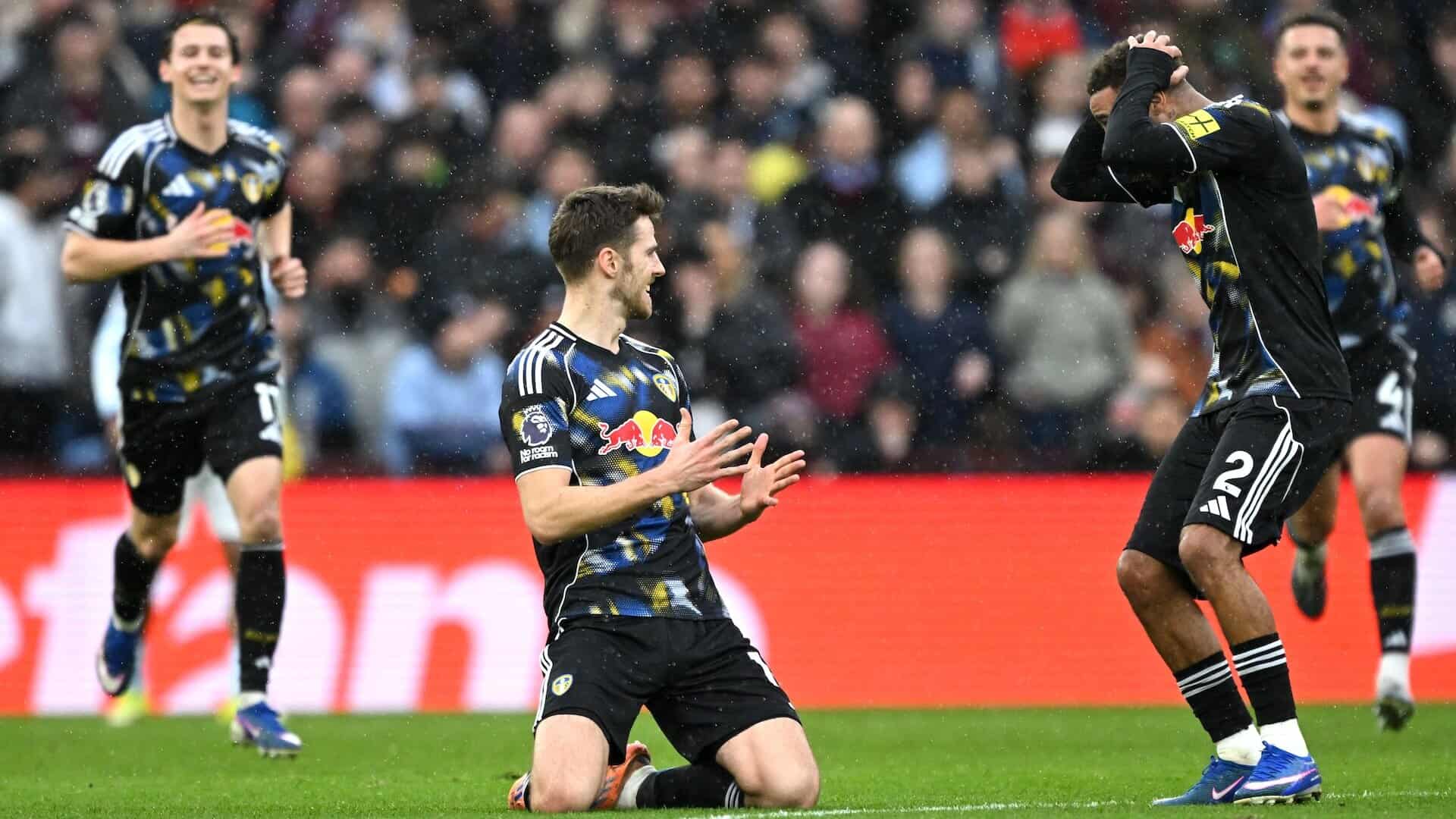
Oh my god
February 23, 2026
Written by: Rob Conlon
When I close my eyes at night I dream of striking a football
as sweetly as Anton Stach. From the daring of its imagination to the quite
frankly sickening brutality and beauty of its execution, Stach’s free-kick at
Villa Park is the type of goal I like to imagine myself scoring for Leeds
United as I let my mind wander when I have more important things to do, or when
I’m staring wistfully out of a train window, or when I’m sitting on the toilet.
It’s the type of sensation I trick myself into remembering
as the rare occasions I also connected with a football properly when playing in
local parks with jumpers for goalposts or five-a-side halls growing up. Yet
deep down, I know those moments were even fewer that I care to admit, and are
undermined by the fact that almost every time it was a complete fluke, a brief
accident courtesy of the law of probability.
Anton Stach, on the other hand, meant it — and that meant it
was all the more spectacular to everyone who witnessed it and went to bed
dreaming of being talented enough to do the same.
I, however, did not witness it. Not at the time, anyway. I
was sitting on a wooden bench up a cliff, drinking a pint outside Whitby
Brewery hoping the rainclouds would quickly pass over. All I knew of the
brilliance that had taken place in Birmingham was the update on BBC Sport’s
live score: ‘Stach (31’)’. A weekend away with my girlfriend and her family was
not quite the Leeds-United-stress-free experience I envisaged. As her dad
constantly refreshed BBC Sport throughout the second half, I advised him to escape
the terror by just ignoring it until full-time, even though my eyes were glued
to his phone screen too.
The news that Tammy Abraham snatched a late equaliser felt
inevitable. The confirmation of the final whistle brought relief tinged with
disappointment. Once again, Leeds United had been so close to letting us all
sleep much easier for the rest of the season, dreaming of Stach’s Goal of the
Season competition with himself.
Watching the game back, I was expecting something of a smash
and grab from Leeds. The nature of Stach’s goal, the yellow card next to Karl
Darlow’s name and Villa’s 74% domination of possession suggested Leeds had gone
to Villa Park and frustrated the hosts in the same way the landfill clubs of
the Championship had tried — and mostly failed — when visiting Elland Road.
Yet as the game unfolded, I was once more struck by a Leeds
performance that provided further evidence this is a very capable Premier
League team.
For all Villa’s possession, the Peacocks largely held their
opponents at arm’s length in a match played between the edges of both penalty
areas. If anyone was more incisive, it was Leeds, Dominic Calvert-Lewin getting
behind the defence early on only for his touch to take him too wide, forcing
him to try to find Brenden Aaronson with defenders back to clear rather than
shoot on goal. Shortly afterwards, a well-spotted pass from Jayden Bogle gave
Calvert-Lewin a similar opportunity. This time his touch was much crisper, but
Emi Martinez reacted quickly to smother his shot.
When Leeds picked their moments to attack, their football
was reassuringly enterprising. Calvert-Lewin and Aaronson switched roles as the
latter nudged a long ball upfield back to the big striker dropping into space
and feeding Gabi Gudmundsson surging forward from the left. After Gudmundsson
cut inside and tried to find the corner, his shot was blocked, but Leeds’
forays were enough to make the home crowd restless. With Villa finding
increasingly laughable ways to make intricate set-piece routines look completely
brainless, swinging crosses straight out of play or to the feet of Leeds
players, the only moment of danger came when Bogle didn’t hear Karl Darlow’s
shout to claim a ball as Emi Buendia’s lob from outside the box dropped wide.
That set the scene for Stach to step forward and leave Tony
Dorigo almost choking in surprise at his second screamer of a free-kick this
season. Dorigo eventually regained enough composure to simply splutter, “Oh my
god!” Had Gruev found the same top corner a few minutes later rather than sweep
a shot from the edge of the penalty area narrowly over the bar then Dorigo may
have been too stunned to ever speak again.
Villa did end the half with a word of warning for Leeds,
Amadou Onana reaching Tyrone Mings’ flick on at the back post, drawing an
excellent stop from Darlow and even finer goalkeeping to swat the loose ball
away from the ground while everyone else was waiting for someone to tap it into
the net.
The second half followed a similar pattern, Leeds
restricting Villa to efforts from long range, including another from Buendia
that Darlow tipped onto the post with his second fine save that got overlooked
as Ollie Watkins’ subsequent tap in was ruled out by an offside flag.
Five minutes later, Daniel Farke made the change I wanted
him to make a month ago at Everton, introducing a second striker in Lukas
Nmecha to help drag Leeds up the pitch rather than settle for defending a lead
in their own half. It almost instantly worked better than anyone could have
hoped as Bogle — who in recent weeks has made himself Leeds’ prime creative hub
from wing-back, like the lovechild of Pablo Hernandez and Bill Ayling — swung a
deep, pinpoint cross into the box and onto the forehead of a diving Nmecha.
Perhaps if it hadn’t been the striker’s very first touch then the outcome would
have been different. Instead, he nodded it too close to Martinez.
Leeds still had more opportunities, Calvert-Lewin toepoking
an improvised attempt at Martinez and Rodon spooning a free header into the air
from a free-kick when Calvert-Lewin was lurking behind him waiting to score,
but Nmecha’s diving header was The Moment, leaving Leeds open to a late
equaliser as cruel as Ezra Konsa meeting a corner at the back post and the ball
looping off Abraham’s knee and up and over Calvert-Lewin on the goal line.
It’s too tempting to wonder how different Leeds’ season
could have been had they held on to a number of winning positions only to be
forced to settle for a draw. “Yes, probably we would fight for Europe,” Farke
said afterwards, albeit while remaining typically level-headed. “We have also
scored several late goals.”
Farke was more bothered about praising his “warriors”, and
he’s right to do so. These are the results that have transformed Leeds’ season
and Farke’s career prospects. United won three of their first thirteen Premier
League games up to and including the day everything changed at Man City. Since
then, their victories have come at only a slightly better rate, four of
fourteen. But Leeds have created a buffer between themselves and the relegation
zone by continuously making sure they are hard to beat, drawing eight times
since December compared to just twice in the first four months of the season.
Ultimately, this season is about staying up, and a point at
Villa Park was another small step to doing just that. Keep this up, and we can
worry about taking the bigger steps to Europe next year.

