Everton 1-1 Leeds United: So close, not so far — Square Ball 28/1/26
No doomscroll
Written by: Rob Conlon
Leeds United are so close to proving they’re an excellent
team that belongs in the Premier League. And that’s what makes winning only a
very decent point at Everton so frustrating.
After a weekend that sent even the most level-headed of
supporters taking a nervous glance over their shoulders at the two sides
directly below United picking up precious victories, Leeds went to Everton with
everyone bracing themselves for a big dollop of post-match self-loathing. Or I
was at least. It’s been a while, to be fair — a little over two months since a
fan was so exasperated with Daniel Farke’s inaction during the home defeat to
Aston Villa he ran into the dugout to tell Leeds’ manager what everyone else
was thinking.
Sometimes it’s easier that way. Occasionally I almost miss
it. At least you know where you stand when you’re feeling pissed off; even if
it’s in a dark room on your own, illuminated only by the light from your phone
screen as you doomscroll through the social media angst.
But this was entirely different. Leeds were superb in their
first 45 minutes at the Hill Dickinson Stadium. After riding out the opening
five minutes of ‘getting it in the mixer to Tarky’ that made David Moyes only a
ginger goatee away from Sean Dyche, Leeds played with an energy and panache
that, had Farke only been sitting in the dugout on a bucket, should have had
fans watching with a pillow over their laps.
Having played right-back and centre-back in his previous two
league appearances, James Justin completed the set by switching to the left in
Gabi Gudmundsson’s absence and mirrored Jayden Bogle’s intensity on the
opposite flank. Leeds’ wing-backs were irrepressible, winning tackles near
their own penalty area one second then reaching the Everton byline a second
later. At one point they were playing as Leeds’ centre-forwards, almost bumping
into each other as they raced to take a shot from Brenden Aaronson’s cutback.
Aaronson was likewise wherever you looked. Playing off
Dominic Calvert-Lewin with Noah Okafor benched, Aaronson had the freedom to
roam across the forward line, intelligently finding space and even more
intelligently putting it to good use. I have no idea what has happened to
Brenden Aaronson, but I’m delighted it has. In the first half he was in a
battle for Man of the Match with Ethan Ampadu, once more playing like a Rolls
Royce in front of the defence.
When Leeds are in their groove like this they must be an
absolute bastard to play against. “We knew what they would do and how they
would play,” Moyes said afterwards, “but we couldn’t make it work.” It’s a
complete contrast to those weeks when Farke appeared on the precipice of being
sacked, when everyone knew what Leeds would do and everyone knew how the
opposition were going to beat it: namely a cross from out wide and a goal from
a midfield runner. Now Leeds are a shapeshifting beast — five at the back out
of possession, four at the back on the ball — and continually leaving
opposition managers scratching their heads.
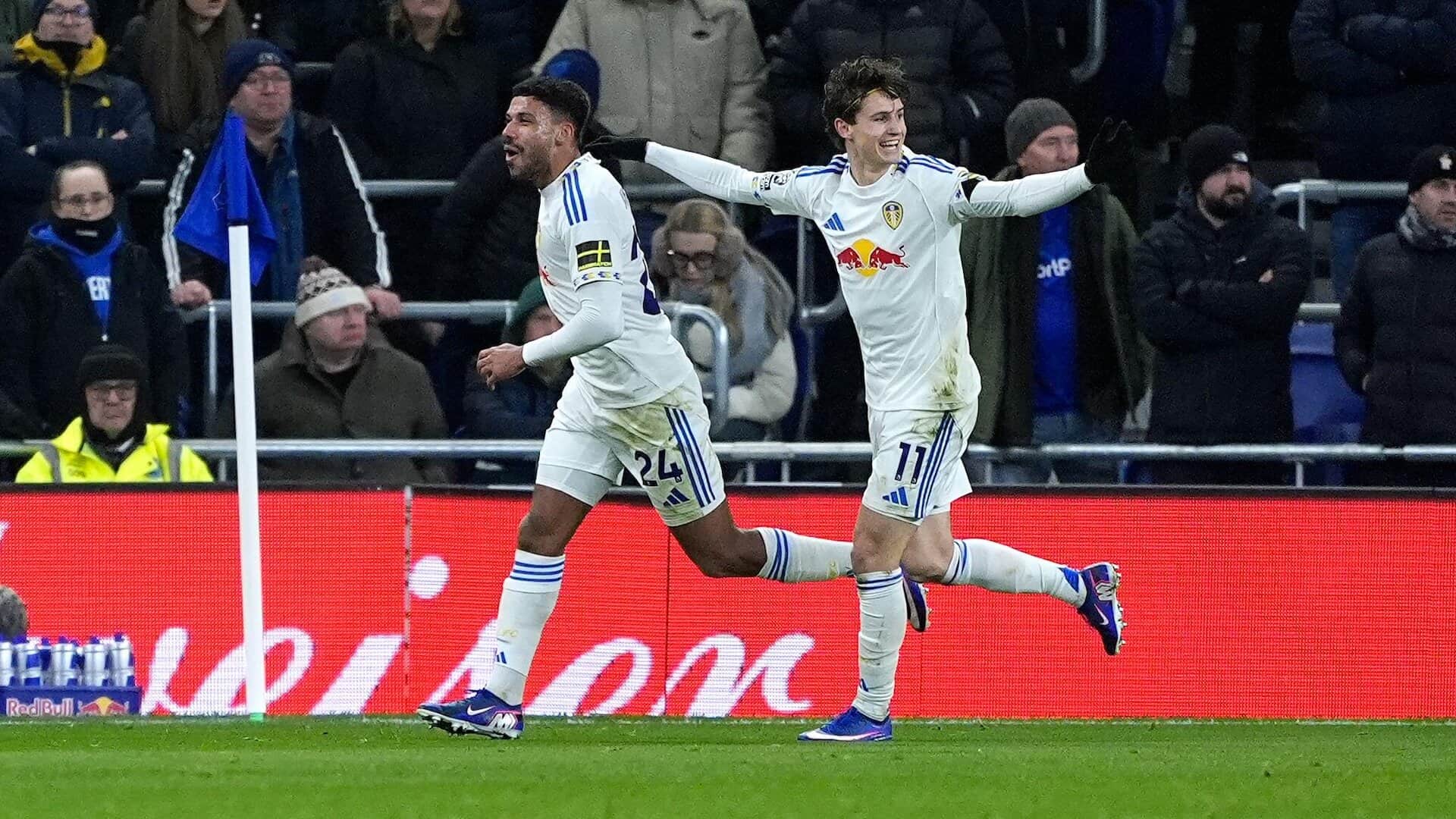
Justin’s opener was just reward for plenty of enterprising,
slick football. Joe Rodon brushed Iliman Ndiaye off the ball and was still
barking at the winger to get up while Bogle was putting Anton Stach into space
to cross. His low ball rolled behind Calvert-Lewin and across the six-yard box
to the back post, where Aaronson left it for Justin to arrive and calmly
finish.
Everton’s crowd were quickly descending towards a meltdown
and Leeds had the game in their grasp. If only Calvert-Lewin’s shot from
Bogle’s cutback had been an inch or two to the left rather than cannon back off
the post, the home fans would have been doing an insurance job on their new
stadium. But as the half ended with Rodon carelessly gifting James Garner a
chance he hit into the side netting, it was hard to escape the fear that Leeds
had left a second goal and a comfortable route to three points out there.
To Moyes’ begrudging credit, his changes at the break gave
Everton a foothold in the game and left Leeds not knowing whether to stick or
twist in protecting their lead. With the hosts’ mirroring United’s formation,
Bogle and Justin no longer had free reign of either wing and were now being
pushed back into their own half, leaving Calvert-Lewin stranded alone up front
and Aaronson and Stach unable to find the balance between supporting the
striker and remaining defensively organised.
When Leeds drew 1-1 with Manchester City in a wild
basketball of a fixture after winning promotion in 2020, Marcelo Bielsa praised
Pep Guardiola for making his side more threatening towards the end of the game
by making a defensive change, swapping an attacker in Riyad Mahrez for a
holding midfielder in Fernandinho. “It was a very smart change,” Bielsa said.
“It had a significant impact.”
If making a defensive change can help a team improve in
attack, then does the inverse also apply? Once Everton brought on a third
centre-back in Jarrad Branthwaite, I was desperate for Farke to introduce Lukas
Nmecha from the bench to give Calvert-Lewin a partner up front in an attempt to
drag Leeds up the pitch. It would have been much more difficult for Everton to
find an equaliser if the ball wasn’t constantly on the edge of United’s penalty
area in the second half.
Farke did turn to his substitutes before his customary
seventy-minute mark, only to pick the wrong option. If a change was to be made
in midfield, the game seemed to be crying out for the doggedness and experience
of Sean Longstaff, so much so I hadn’t even considered Ao Tanaka would be the
man to replace Ilia Gruev. Farke has criticised Tanaka for being caught out of
position in the past, and so it transpired once again. Tanaka was too slow to
stop Idrissa Gueye’s cross that was flicked in at the near post by Thierno
Barry from almost the exact same position Calvert-Lewin had hit the post.
Leeds were grateful for the woodwork shortly afterwards as
Gueye’s shot from the edge of the box hit the crossbar, at which point the
cavalry arrived in Longstaff, Noah Okafor and Facundo Buonanotte. To add to the
irritation, the changes worked. They were just too late. Okafor broke from deep
and teed up Longstaff to shoot over, while Justin headed over at the near post
after a succession of corners in stoppage time as Leeds finally had enough of a
foothold to venture out of their own half of the pitch.
The irony is that if this game was flipped on its head we
would probably be feeling a lot better about it. Had Farke started with the
wrong team and finished with the right one it would be hailed as a tactical
masterstroke. Had Leeds been insipid and snatched a draw with a smash and grab
away from home rather than given us a 45-minute glimpse of some of the best
football we’ve played all season it would have felt like a point earned rather
than two dropped. Had we been able to look upon our 26 points on the board and
felt like it was more than we deserved instead of fewer than we should have won
we would be thanking our lucky stars and praising the Lord.
Yet for all we’d have been waking up on Tuesday morning
without the bitter taste of frustration on our tongues, we’d have also felt a
lot further away from Leeds United proving they’re an excellent team that
belongs in the Premier League. And that’s what makes winning only a very decent
point at Everton so frustrating.
