Sunderland 1-1 Leeds United: Looking Up — Square Ball 29/12/25
No Dancing
Written by: Rob Conlon
With a minute left of normal time, Jaka Bijol put his name
and forehead on a ball into Leeds’ half of the pitch and cleared it to safety,
getting a kick in his midriff from a Sunderland player for his troubles. It was
a foul, but Bijol wasn’t getting any sympathy from the referee, who pointed for
a Sunderland throw-in. He wasn’t getting any sympathy from his captain, either.
From a few yards away, Ethan Ampadu beckoned his teammate to his feet and waved
him back into position. “Get up! Get up!” Still grimacing from the kick, Bijol
did what he was told — and spent the remaining few minutes making sure Leeds
left the Stadium of Light with the point that was the least they deserved.
A 1-1 draw made it five games without defeat for Leeds,
hopefully underlining December 2025 as the defining run of form that will mean
they are still a Premier League club come August 2026. A month ago we were
waiting for Daniel Farke to be sacked, resigned to the inevitable and terrified
of what was to come next. Now Leeds are 16th in the table after eighteen games;
twenty points on the board, seven clear of the bottom three, six short of 8th.
Players both new and old revitalised all over the pitch. Would we have taken
that before the season began? I’m loath to speak on your behalf — but yes we
bloody would have.
The only shame about the last month is that so much of the
analysis has focussed on the change in formation to 3-5-2, as if this is all
down to Farke moving a few pieces around on a chess board. Tactical clarity
(copyright: Jesse Marsch) has no doubt helped Leeds in the last five games, but
it has been secondary to a grit in the stomach and no shortage of skill in the
boots. The comebacks against Man City and Liverpool. Ao Tanaka hitting the
bottom corner against Chelsea. Dominic Calvert-Lewin’s refound composure in
front of goal. A formation can only do so much, but with a little help from the
bloke in the dugout — including a half-time bollocking at the Stadium of Light
— the players on the pitch are continuing to show different sides to themselves
with each passing match.
There was no greater exhibit at Sunderland than Leeds’
equaliser in the second half. Having had so much success in the preceding games
playing direct into Calvert-Lewin and capitalising on set-pieces, Farke reacted
to Joe Rodon’s injury and Simon Adingra’s annoyingly classy opener by reverting
to 4-3-3 and asking his players to get the ball on the ground and play the type
of football with which they beat Sunderland to the Championship title last
season by 24 points.
Twelve passes between all eleven players in a blue and
yellow (plus one bright orange) shirt arrived only a couple of minutes after
half-time. A one-two between Pascal Struijk and Gabi Gudmundsson quickly
quietened the home fans cheering their team’s attempts to win the ball back
high up the pitch. A backheel from Noah Okafor opened up the midfield for Anton
Stach, whose sweeping pass to the right wing gave Brenden Aaronson the two
things I often cringe when he is faced with — time and space. Perhaps the biggest
sign things are changing for the better is that as Aaronson got the ball he had
clear instructions in his mind, as he told The Athletic afterwards:
“I didn’t even see the first part of it because I was
spinning to go out wide and the coach always talks about, ‘We want one guy
inside and one guy outside.’ I saw Jayden was a bit inside. I don’t really like
going outside because I’m not a winger-winger, but I went outside and I’ve been
working on trying to be as direct as I can, find a little bit of space, and put
the ball into Dom because I know he’s going to be there.”
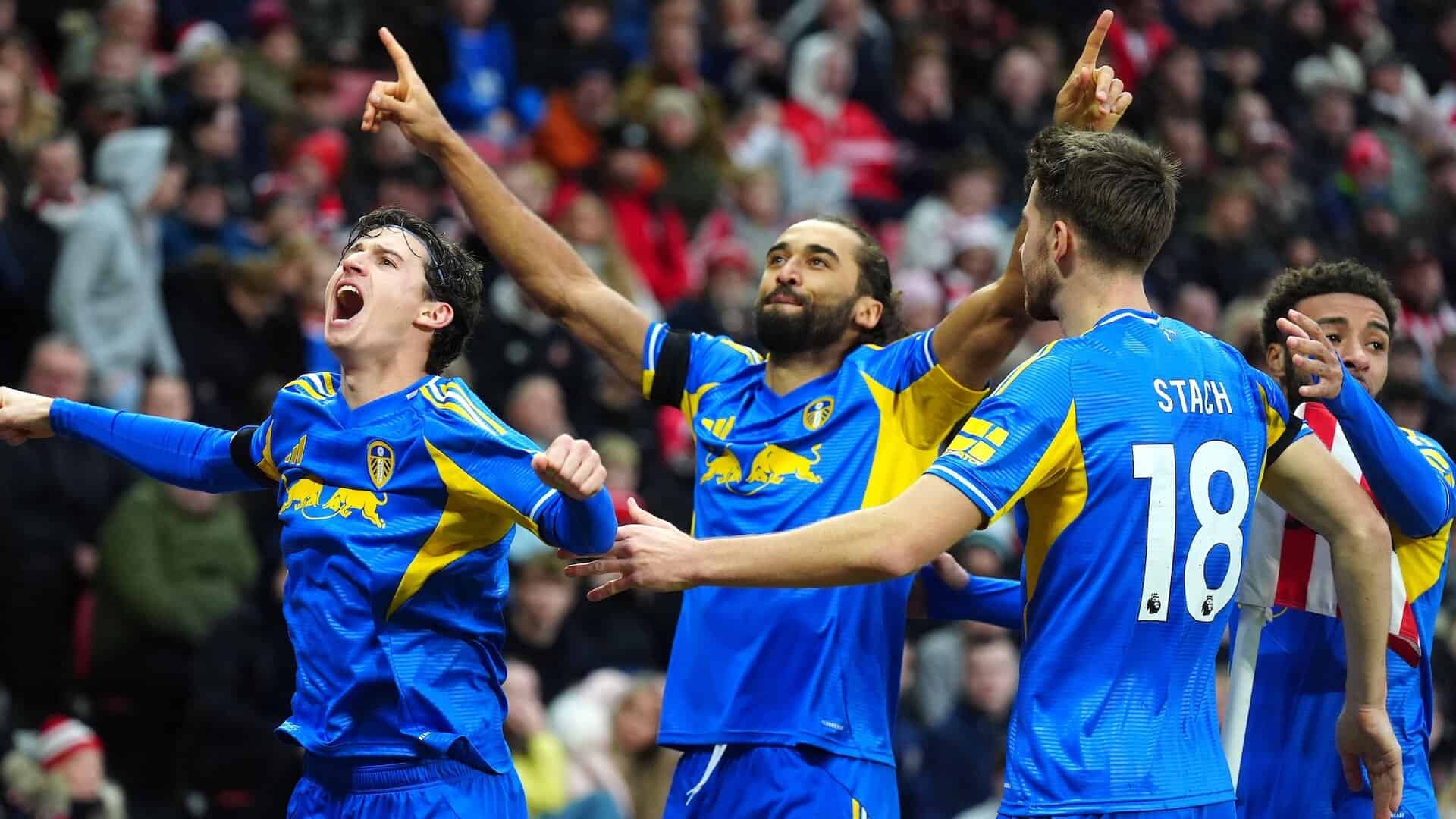
Both Aaronson and Calvert-Lewin made the most difficult part
of football look simple. Neither Aaronson’s pass nor Calvert-Lewin’s finish
were fancy or complicated. They were precise. The right touches at the right
time.
Minutes later, they should have been followed by a second
goal as Okafor’s cross was flicked on by Aaronson towards the back post, where
Jayden Bogle couldn’t bundle the awkwardly bouncing ball either over the line
or back to Calvert-Lewin waiting for a tap-in, instead diverting it wide off
his thigh. While subsequent opportunities were never quite as clear cut, Leeds
were superior in maintaining the pressure. Tanaka fluffed a cutback over with
his weaker left foot. With Sunderland bullied deep into their own half, Stach
and Ampadu both had attempts from the edge of the box.
The only blemishes on the performance were linked. We are
used to seeing Rodon looking hurt — he always appears pained — but it was a
worry when he went down twice in the first half clearly struggling with his
ankle rather than one of his customary knocks to his noggin. There was an
element of predictability, however. On Christmas Eve, The Athletic published an
interview with Rodon about his 103 consecutive appearances leaving him only ten
away from Norman Hunter’s sixty-year-old record. Rodon’s determination to play
on was admirable, but costly — hobbling away from defending a set-piece, he
played Adingra onside from Granit Xhaka’s clever pass behind Bogle, giving
Adingra the space to impressively arc the ball into Lucas Perri’s far corner. I
blame Beren Cross.
Until that moment, it had been a stodge of a game, much like
Leeds’ trip to Brentford. Seconds earlier, I had been about to comment to a
friend about how nothing had really happened only to be shut up by Adingra. But
the goal — and Farke’s turning to Tanaka to replace Rodon rather than the more
logical choice of Sebastiaan Bornauw — sparked the game into life. Playing with
a brightness we’ve rarely seen during his time at Leeds, Aaronson got on the
end of a cross and kept calm to make space and shoot past Robin Roefs, only for
Trai Hume to clear the ball off the line. Ultimately, Leeds were grateful it
was still just 1-0 at half-time as Brian Brobbey failed to make the most of
being put through one on one with Perri before clipping the crossbar with a
header after Sunderland countered and crossed to the striker free at the back
post.
There are, after all, two teams on a pitch, and Sunderland’s
unbeaten home record since winning the play-off final meant it was always going
to be a difficult afternoon for Leeds to navigate. The first half showed that
playing 3-5-2 isn’t the answer to all of Leeds’ problems, but the second half
proved that the players and manager are learning how to adapt and hold their
nerve, right down to the final few minutes as Sunderland tried to find a late
goal and Ampadu told Bijol to stop moaning and keep fighting.
A win would have felt priceless; failure to take all three
points meant Farke vowed there would be “no dancing”. But a draw remained a
valuable result to round off an excellent 2025 for Leeds United, with the
promise that there can be plenty more to enjoy in 2026.

